
The Bungaroosh, Flint, & Lime Specialists in Brighton & Hove
Diagnosis and repair of persistent damp, mould, failed plaster and cracked render in Regency, Victorian and Edwardian properties across Brighton and Hove.
Construction-Led Specialist Diagnostics
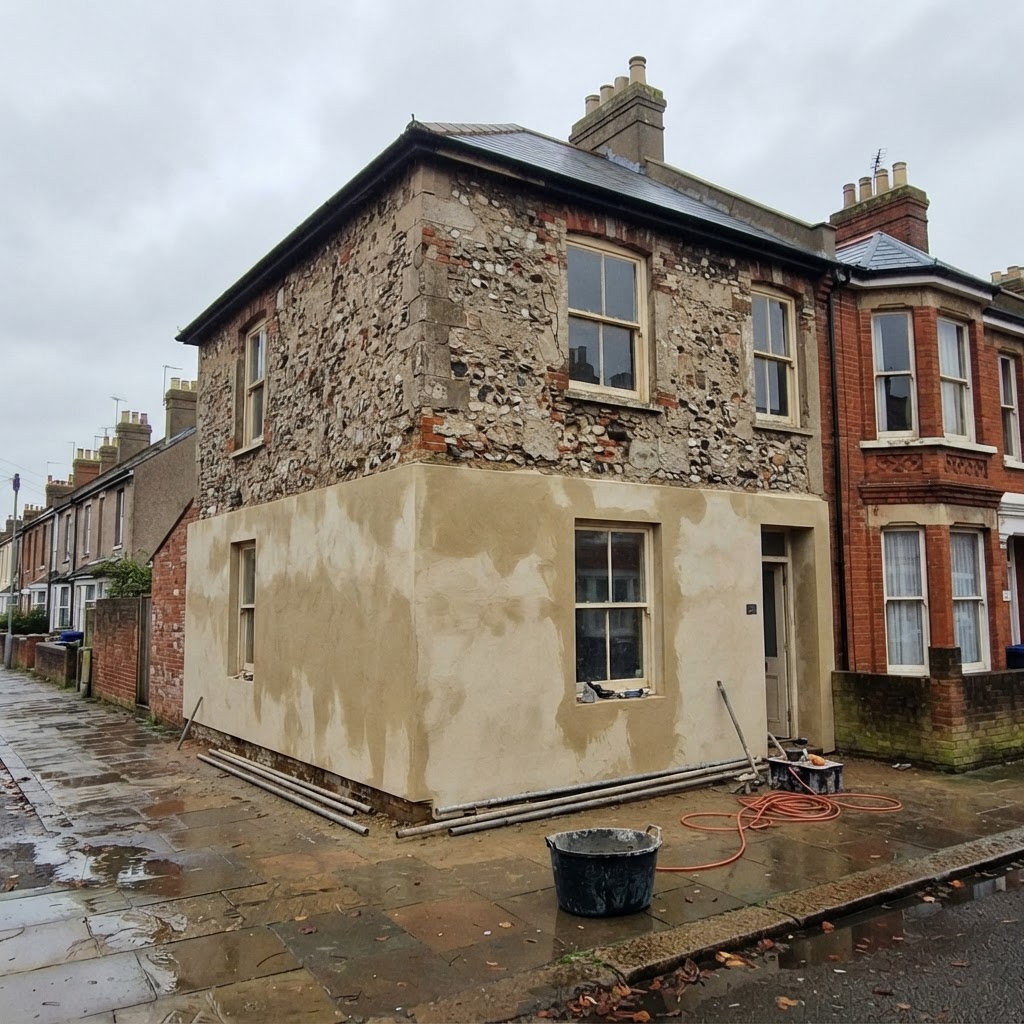
Many older buildings in Brighton & Hove contain bungaroosh, flint, lime mortar, soft brick and mixed solid-wall construction. These walls behave differently from modern cavity walls and cannot always be repaired successfully using standard damp-proofing treatments or dense modern finishes.
Where cement render, gypsum plaster, waterproof coatings or non-breathable paint restrict drying, moisture may remain trapped within the building fabric.
For many local properties, the correct repair is to:
- Identify and correct the source of excess moisture
- Understand the original wall construction
- Remove incompatible materials where justified
- Repair damaged bungaroosh or masonry
- Reinstate suitable lime render and lime plaster
- Allow the wall to dry under appropriate conditions
- Finish with compatible breathable decoration
Heritage Building Services in Brighton & Hove
Specialist repair and restoration of traditional solid-wall buildings — from diagnosis through to compatible, breathable finishes.
The Safe-Bricks Diagnostic Journey
Every project follows a considered, construction-led sequence — not a predetermined treatment. The stages below are adapted to the specific wall, property and moisture condition.
Identify the Construction
Establish whether the wall contains bungaroosh, flint, brick, lime mortar or mixed masonry. The construction type determines which materials and finishes are compatible.
Investigate Moisture Sources
Trace where moisture is entering — roof or plumbing leaks, defective gutters, cracked render, failed chimneys, condensation or ventilation. Readings are considered alongside construction and exposure.
Repair Active Defects
Correct the source of excess moisture before addressing wall finishes. A lime system cannot support drying if the moisture source remains active.
Assess Existing Finishes
Determine whether cement render, gypsum plaster, chemical injections or non-breathable paint are restricting moisture movement and evaporation.
Remove Incompatible Materials
Where justified, remove materials that restrict drying. This is a considered decision based on the wall construction and condition, not a blanket strip.
Reinstate an Appropriate Lime System
Reinstate suitable lime render externally and lime plaster internally, with repairs to bungaroosh and masonry as required. The specification depends on the wall.
Allow Controlled Drying
Allow sufficient curing and drying time before applying decorative finishes. Rushing this stage can reintroduce moisture problems.
Apply Compatible Decoration
Finish with breathable coatings compatible with the lime system. The wall can now manage moisture through vapour-permeable materials as it was originally intended.
Why Damp Repairs Often Fail in Older Properties
Recurring damp is frequently treated as a surface problem. A wall may be injected, sealed, tanked, replastered or repainted without first establishing:
- What the wall is made from
- Where moisture is entering
- Whether the source is still active
- Whether previous materials are restricting evaporation
- Whether condensation or ventilation is contributing
- Whether the underlying wall has deteriorated
This approach may temporarily conceal staining or mould without resolving the condition of the wall behind the finish.
Brighton & Hove's housing stock presents particular challenges. A single elevation may contain bungaroosh, flint, brick, chalk, rubble, timber and later cement repairs. A treatment designed for uniform modern brickwork may therefore be unsuitable if the original construction has not first been identified — see our guide to bungaroosh repairs in Brighton and Hove.
Standard treatment-led approaches can be particularly problematic where they rely on:
- Chemical damp-proof course injections
- Waterproof tanking systems (see basement damp-proofing)
- Dense cementitious coatings
- Gypsum plaster on damp solid walls
- Hard cement render or pointing
- Impermeable internal or external paint
These products are not unsuitable in every building or location. The risk arises when they are used on traditional walls that depend on vapour- and moisture-permeable materials to dry effectively.
Recent specialist restoration work
A selection of completed case studies from bungaroosh, lime and traditional-building projects across Brighton, Hove and East Sussex.
15 College Terrace
Failed lath and plaster through the hallway, living room and top-floor bedrooms, mould in the top floor and a damp living room wall — stripped back, treated, structurally repaired, lime-plastered throughout and eight original sash windows restored.
View case study28 Brunswick Terrace
Cracked, delaminating cement render on the rear of a Grade I listed terrace was removed on a surveyor's recommendation, revealing a 2m² void in the bungaroosh behind it — rebuilt in hydraulic lime with salvaged flints via basement and four-lift scaffold access.
View case study

58 & 60 Brunswick Street West
Widespread render failure across two adjoining facades — extensive cracking, delamination and moisture-related failure of the existing cement render coat, investigated at high level via scaffold.
View case studyWhy Choose Safe-Bricks Limited?
Select any point below to read what it means in practice.
Listed buildings and properties in conservation areas may require additional approvals depending on the scope and effect of the proposed work. Where relevant, this should be established before work begins.
Tell Us What You Need
Select the option that best describes your situation and we will take you straight into the enquiry form with the details pre-filled. This does not diagnose your building, but it gives us the context we need to respond quickly.
Photographs are useful for initial review but do not replace an inspection or technical diagnosis. Where remedial work is being considered, an on-site inspection is always recommended.
Reviewed on Google
5.0 rating on Google
Our clients have shared their experience working with Safe-Bricks on Google. Read their reviews on our Google Business Profile to see what local property owners say about our specialist restoration work.
Best Heritage Construction Specialists 2026
Safe-Bricks Limited have been recognised as the Best Heritage Construction Specialists for 2026, highlighting our specialist standing in traditional building restoration across Brighton, Hove and East Sussex.
Contact Brighton's Bungaroosh and Lime Render Experts
Recurring damp in an older property should not be repeatedly injected, sealed or covered without understanding why the wall remains wet.
For many Brighton & Hove properties, the correct approach is to repair the moisture source, remove incompatible cement, gypsum or impermeable coatings where necessary, and reinstate suitable lime render and lime plaster so the wall can dry correctly.