
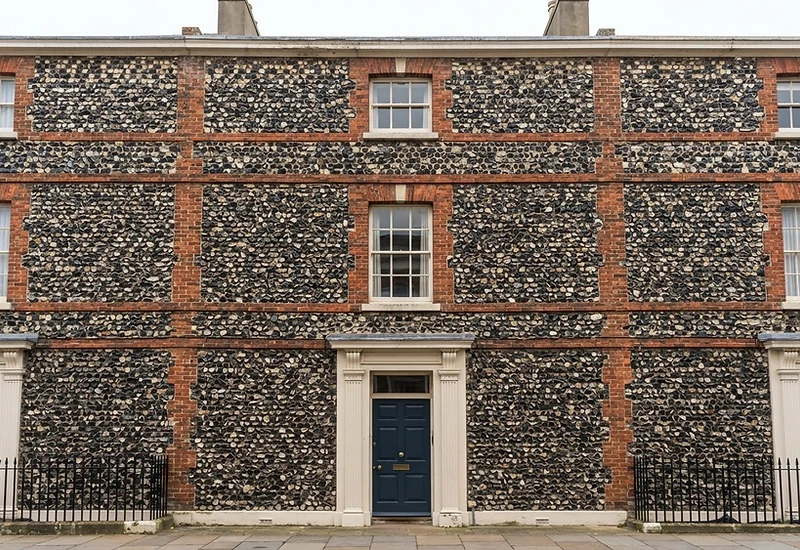
Bungaroosh wall repair specialists in Brighton and Hove
Bungaroosh is a composite wall construction distinctive to Brighton and Hove — flint, brick, chalk and lime mortar cast against shuttering. Safe-Bricks surveys, repairs and rebuilds these walls in materials compatible with the original construction.
We are instructed on walls that are moving, bulging, shedding their finish or have already come down in part — most often free-standing boundary and garden walls, rear elevations and basement-level walls where water has been held against the fabric for years.
Every instruction starts with a booked diagnostic survey. The wall is identified and sounded, cracking is traced on both faces, the moisture mechanism is established, and the extent of deteriorated material is mapped. Only then is a repair specification issued — a bungaroosh wall cannot be priced from a photograph because its composition varies within a single elevation.
Safe-Bricks is one of the few Brighton contractors that treats bungaroosh as a specific construction type rather than applying generic masonry repair methods to it. We carry out extensive structural work on bungaroosh houses as well as smaller localised repairs, and we have a long track record of both — with previous clients who are happy to speak to prospective clients about the work we did for them.
What Is Bungaroosh?
Bungaroosh is a local building material found extensively across Brighton and Hove, particularly in Regency and early-Victorian properties.
It was formed by casting a mixture of flint, brick, chalk and other available aggregates against timber shuttering, bound together in a lime-rich mortar. Once the shuttering was removed, the face was typically rendered or plastered to provide a continuous finish.
The result is a solid wall of considerable mass but variable composition. Two adjacent sections of the same wall can have very different material content, strength and density.
Why Bungaroosh Needs a Different Approach
Bungaroosh's mixed composition means it does not behave like brick, blockwork or flint laid in regular courses.
Hard cement renders, dense plasters and aggressive mechanical preparation can all damage the original material or trap moisture within the wall.
Repairs therefore need to be selected with the construction in mind, not applied generically.
Common issues we encounter with bungaroosh walls include:
- Spalling or surface loss where hard finishes have been applied
- Hollow or delaminating render
- Localised softening of the original mortar matrix
- Cracking at junctions with brick or flint
- Damp staining associated with trapped moisture
- Previous inappropriate repairs using cement
- Voids and pockets within the wall section
Each of these has a different appropriate response. Diagnosis comes before specification.
Book a diagnostic survey
The survey is the instruction point for all repair work. It establishes what has failed, why it has failed, and what has to be done before any rebuilding begins.
A diagnostic survey covers:
- Confirmation of the construction and whether the wall is cast bungaroosh or faced flint
- Sounding of the wall face to map areas where the lime matrix has lost cohesion
- Crack tracing on both faces to separate structural movement from finish failure
- Identification of the wetting mechanism — rainwater goods, ground levels, copings, plumbing or ingress at the base
- Assessment of previous cement repairs and their effect on the surrounding fabric
- Whether temporary support is required before work proceeds
- The extent of rebuilding, repointing and finish reinstatement to be specified
Where a wall is actively moving or has partially collapsed, temporary works are addressed first. We do not quote for rebuilding until the wall has been inspected.
When Is Bungaroosh Repair Necessary?
Not every bungaroosh wall requires repair. Many perform perfectly well and have done so for well over a century.
Repair becomes appropriate where the wall is showing genuine signs of deterioration, where previous interventions are causing problems, or where the construction is being altered as part of a wider project.
Signs that bungaroosh may need attention include:
- Loose, hollow or fallen render
- Visible softening of the wall face
- Damp staining internally that correlates with external defects
- Cracking that follows the wall's mixed composition
- Spalling caused by trapped moisture
- Previous cement-based repairs that are now failing
- Structural movement requiring investigation
Where the wall is sound, unnecessary removal or intervention is avoided.
Structural repair of collapsed and bulging walls
Free-standing boundary and garden walls fail more often than elevations because they are wetted from both faces and from above, and have no floor or roof structure restraining them. A failed coping or a raised bed against the base is frequently the whole cause.
Repair is carried out by dismantling back to stable material, supporting the retained wall where required, and rebuilding in lifts so each lift gains strength before the next is placed. Reclaimed flint, brick and chalk are re-used where they are sound.
Structural repair work we undertake:
- Rebuilding partially collapsed boundary and garden walls in compatible lime mortar
- Temporary support and stabilisation of bulging or displaced sections
- Taking down and rebuilding failed sections of elevation in lifts
- Consolidation of soft, friable material and filling of internal voids
- Repair of junctions with brick, flint and adjoining construction
- Reforming copings, bases and ground levels so water is shed away from the wall
- Repointing in lime mortar specified to the wall, not to a standard mix
Full replacement in modern blockwork is rarely appropriate on a historic wall, and on a listed property or within a conservation area may not be permitted. Where the wall is faced flint rather than cast bungaroosh, the work falls under traditional flint and lime masonry restoration, which is specified separately.
Replacing incompatible cement repairs with breathable lime
Cement mortar and cement render are stronger, more rigid and far less permeable than the wall behind them. On bungaroosh they trap moisture in the wall section, concentrate it behind the repair, and transfer stress into the softer fabric — so the surrounding material fails before the repair does.
Where cement work is causing that pattern of damage, we remove it carefully by hand and reinstate in a lime system specified to be weaker and more permeable than the wall: vapour-open, able to accommodate small movement, and sacrificial so that future work removes the repair rather than the historic fabric.
Why Lime Is a Diagnostic Necessity, Not a Preference
On a solid wall there is no cavity and no damp-proof membrane. The wall takes up moisture during driving rain and gives it back up when conditions allow, and the finish has to permit that exchange. This is the whole basis of lime rendering Brighton properties correctly: the coating is chosen to be weaker and more permeable than the wall behind it, so evaporation happens through the render rather than being forced into the fabric.
Cement render, sand-and-cement patching, plastic masonry paint and dense gypsum plasters all restrict that movement. Because they are also stronger and more rigid than bungaroosh, the moisture and the stress are both transferred into the softer material — which is why the wall spalls around a cement repair while the repair itself stays intact. Injected chemical damp-proof courses and internal waterproof tanking have the same effect: they relocate moisture rather than remove its cause.
For that reason the choice of lime is an outcome of diagnosis, not a default specification. We establish the wetting mechanism, the exposure of the elevation and the condition of the original matrix first, then specify a binder and mix that suits those findings.
Lime Mix Ratios for a Coastal Exposure
Brighton and Hove elevations face wind-driven rain carrying salt, followed by rapid drying. A mix specified for a sheltered inland wall will not survive that cycle, so the binder is selected by exposure and by the strength of the substrate.
Mixes we typically specify, adjusted on site to the wall itself:
- Sheltered and internal work, sound matrix: non-hydraulic lime putty at 1:2.5 to 1:3 with a sharp, well-graded sand
- General external render on bungaroosh: feebly to moderately hydraulic lime (NHL 2 to NHL 3.5) at 1:2.5 to 1:3
- Exposed seafront and south-west elevations: NHL 3.5 at 1:2.5, with the base coat no stronger than the wall and each coat weaker than the one beneath it
- Copings, plinths and wall heads taking direct wetting: NHL 3.5, with a graded sand and reduced water content
- Repointing: mix matched to the surrounding mortar by binder and aggregate, never a single house mix applied across a whole elevation
- A proportion of well-burnt brick dust or fine aggregate where a coarser original matrix needs matching
NHL 5 and cement gauging are not used on bungaroosh. A binder stronger than the wall shifts the point of failure into the historic material.
The Multi-Stage Cure in the Brighton Climate
Lime does not set on a fixed timetable. Hydraulic lime gains initial strength through hydration and then continues to carbonate over months as it reacts with carbon dioxide, and both processes need controlled moisture. Coastal conditions work against this from both directions — sea wind can dry a coat within hours, while a still, damp autumn week can hold a coat wet enough to stall it.
The staged programme we work to:
- Substrate preparation and controlled dampening so the wall does not draw water out of the fresh coat
- Scratch coat applied and protected, then allowed to firm without drying — typically dampened two to three times daily in warm or windy weather
- Minimum of three to seven days between coats depending on temperature, exposure and coat thickness
- Float coat applied only once the scratch coat has taken up initial set, keyed and dampened rather than wetted through
- Hessian or debris netting maintained over the scaffold for shading and wind protection throughout
- Finish coat applied last, then protected for a further week as carbonation begins to run through the section
- Decoration in limewash or mineral paint deferred until carbonation is well advanced — several weeks at least, and longer on thicker sections
Work is not carried out below 5°C, in frost risk, or in direct strong sun without shading. Where the season will not allow a proper cure, the work is programmed rather than rushed — a coat forced to dry cracks, dusts and has to be taken off again.
Completed Bungaroosh and Solid-Wall Repairs
Written case studies setting out what was found on site, what was agreed and what was carried out — including exposed seafront elevations where wind-driven rain and salt place the greatest demand on a repair.
28 Brunswick Terrace, Brighton
Brunswick Town, BrightonFailed bungaroosh taken down and rebuilt in compatible lime, on a listed seafront terrace.
View case studyRender repair & decoration58 & 60 Brunswick Street West, Hove
Brunswick Street West, HoveTwo Victorian townhouses: failed render removed, elevations reinstated and redecorated.
View case studyLime replastering15 College Terrace, Brighton
College Terrace, BrightonInternal lime replastering and sash restoration across a full period property.
View case studyWhere the Finish Fits Into a Repair
The finish on a bungaroosh wall is not just decorative — it forms part of how the wall manages moisture, so a repair is not complete until the face is reinstated.
Removal of a failed finish is handled carefully as part of the repair: the wall beneath can be softer than the coating over it, and aggressive mechanical removal causes real damage.
The specification of the replacement lime render or plaster itself, and the way it is built up and cured, is covered on our lime and traditional finishes page — including cost, curing and consent for lime rendering work.
Bungaroosh and Damp
Bungaroosh is sometimes blamed for damp problems that actually originate elsewhere.
Moisture in a bungaroosh wall can come from leaking rainwater goods, high external ground levels, defective pointing, plumbing leaks or condensation — none of which are caused by the bungaroosh itself.
Before any wall is opened up or render removed, we investigate the likely moisture source. A moisture-meter reading alone does not establish whether the bungaroosh is the problem or whether the wall is simply the victim of an external defect.
Bungaroosh in Extensions and Garage Conversions
Where a garage conversion, extension or alteration connects to a bungaroosh wall, the junction between new and traditional construction needs particular attention.
Modern insulated construction behaves differently from a solid bungaroosh wall. If the junction is not properly resolved, moisture and thermal problems can occur at the interface.
We assess the bungaroosh before specifying how the new work should connect to it.
Listed Buildings and Conservation Areas
Many bungaroosh properties in Brighton and Hove are listed or sit within conservation areas.
Repairs to external walls, render and finishes may require Listed Building Consent or fall under conservation-area controls. We can advise on the likely requirements and ensure work is specified in a way that respects the building's historic character.
Why Safe-Bricks for Bungaroosh
Bungaroosh is not a material most contractors are familiar with. Standard modern repair methods can cause real harm to these walls.
Safe-Bricks approaches bungaroosh as a specific construction type, diagnoses the actual problem before specifying work, and uses materials compatible with the original building.
We will not recommend removing render or rebuilding a wall unless the condition genuinely justifies it.
An established structural track record on bungaroosh buildings
Safe-Bricks has worked on bungaroosh properties across Brighton and Hove for many years — not only surface repairs and finishes, but substantial structural work on houses where the fabric itself had failed. That record is why surveyors, architects and homeowners come to us when a bungaroosh wall is genuinely moving.
Extensive structural work on bungaroosh houses
Our work on these buildings goes well beyond patching a wall face. We take down and rebuild failed sections of elevation in lifts, stabilise bulging and displaced walls, form and support new structural openings, underpin and repair basement-level walls, and carry out full re-facing and re-rendering of whole elevations in compatible lime systems.
Big jobs and small jobs alike
We are equally willing to rebuild a collapsed garden wall, repoint a single bay, or take on a whole-house structural restoration running over several months. The same diagnostic approach and the same specification discipline apply whatever the size of the instruction.
Previous clients happy to speak with you
A number of our bungaroosh clients in Brighton and Hove have offered to speak directly with prospective clients about the work we carried out for them. If you would like a reference before committing to a survey or a scheme of repair, ask us and we will arrange an introduction.
Living with Bungaroosh: Practical Advice & Diagnostics
Most of the questions we are asked as bungaroosh specialists in Brighton and Hove are not about rebuilding walls. They are about everyday decisions — where a cupboard can be fixed, why a previously rendered elevation has started to break up, and what an insurer will want to know. The answers all come back to the same point: the wall is a soft, lime-bound composite of flint, brick, chalk and rubble, and it behaves quite differently from modern masonry.
Hanging heavy items safely
A standard plastic wall plug relies on the surrounding material being consistent and strong enough to resist expansion. Bungaroosh offers neither. Drill in one position and you may hit a flint cobble that deflects the bit; drill 100mm to the side and the bit may pass into soft chalk or lime-rich rubble that crumbles as the plug expands. The plug then spins in an oversized hole, and the load is carried by a pocket of material with almost no tensile strength. Kitchen units, boilers, cast-iron radiators, wall-hung televisions and heavy shelving fail in exactly this way, and the failure usually takes a cone of wall with it.
The correct approach is a chemical fixing. A resin anchor — a vinylester or epoxy resin injected into a cleaned, dust-free hole around a threaded stud or perforated sleeve — bonds along the full depth of the hole rather than gripping at one point. The load is spread through a much larger volume of the wall, which is precisely what a weak, irregular material needs. Points that matter in practice:
- Use perforated resin sleeves in voided or friable material so the resin keys outwards rather than running away into the wall.
- Drill slowly on rotary-only, never hammer action: percussion fractures the lime matrix and loosens flint inclusions around the hole.
- Blow and brush the hole clean — resin will not bond to lime dust.
- Set anchors at a generous embedment depth, and space multiple fixings so they do not share one weak pocket.
- Allow the full manufacturer's cure time before loading, and be aware that cure is slower in a cold, damp solid wall.
- For very heavy items, consider spreading the load across a timber batten or plate rather than relying on isolated fixings.
Where a fixing is structural — a bearing, a bracket carrying floor loads, or anything supporting people — it should be designed rather than assumed, and the wall opened up so what is actually behind the plaster can be seen.
What cement actually does to a bungaroosh wall
Bungaroosh works because it is vapour-open. Rain and ground moisture inevitably enter a solid wall, and lime mortar allows that moisture to move back out through the mortar and evaporate from the surface. The wall is designed to get damp and then dry.
Ordinary Portland cement changes this in three ways at once. Chemically, cement cures by hydration into a dense, hard matrix of calcium silicate hydrates, with a very fine pore structure — unlike lime, which carbonates slowly into a softer, coarsely porous material that continues to allow vapour transfer. Physically, that dense skin has a far higher vapour resistance, so evaporation is throttled: the wall keeps taking moisture in at cracks, junctions and ground level but can no longer release it. Mechanically, cement is stronger, stiffer and has a different thermal and moisture movement to the soft wall behind it, so the two cannot move together.
The failure sequence follows from that. Moisture accumulates behind the render and concentrates at the interface. Chalk and lime-rich material in the wall soften and lose cohesion. Any soluble salts carried in solution crystallise at the point where drying is blocked, and that crystallisation exerts pressure. Freeze–thaw cycling in winter does the rest. The render loses its bond and sounds hollow, then cracks along its own rigid lines, and finally detaches in sheets or panels — the wall "blowing" that owners describe. Critically, the material lost is not just the render: the outer face of the bungaroosh comes away with it, because the cement is stronger than the wall it was applied to. Trapped moisture of this kind is a symptom rather than the fault itself, so the route the water is taking should be established before any finish is renewed — the same discipline we apply to diagnosing damp and moisture issues in solid-walled buildings. Removing sound-but-inappropriate cement is itself a careful operation, and the reinstated finish must be a breathable lime system chosen to suit the exposure — see our traditional lime finishes and the comparison of lime and cement render.
Insurance and surveys on bungaroosh properties
Bungaroosh is classed as non-standard construction, so insurers and lenders assess it on condition and maintenance rather than treating the material as a defect in itself. Cover is generally available, but it is more often placed with insurers who underwrite period and non-standard buildings individually rather than through a purely automated quote, and premiums or excesses can be loaded where there is a history of movement, water ingress or failed external finishes. A property in good order, with sound breathable finishes and clear rainwater goods, is not unusual to insure in Brighton and Hove.
Specialist reporting is commonly requested in specific circumstances: visible cracking, bulging or displacement; extensive cement render on an older elevation; persistent internal damp; or a purchase where a general building survey has recommended further investigation by someone familiar with the material. A standard homebuyer report will often flag bungaroosh and then defer — which is why a targeted inspection by bungaroosh specialists in Brighton is usually more useful than a further generic survey. Where the question is one of stability rather than material condition — displacement, altered bearings or a wall that has moved — insurers and purchasers will expect the opinion of specialist structural engineers in Brighton and Hove alongside the repair specification.
Two practical points protect a future claim. First, gradual deterioration and lack of maintenance are ordinarily excluded, whereas a sudden event such as escape of water or storm damage may be covered, so the moisture mechanism should be established and documented rather than described loosely. Second, repairs carried out in materials incompatible with the original construction can be treated as poor workmanship if they contribute to later failure — keep the specification, materials and any consents on record. Listed and conservation-area properties should also be insured on terms that reflect the requirement to repair in like-for-like traditional materials. Policy wording varies, so specific cover should always be confirmed with your insurer or broker for the individual property.
Living with Bungaroosh: Maintenance and Practical Advice
Most of the questions we are asked about living in a bungaroosh property concern day-to-day practicalities — fixings, finishes and insurance — rather than major repair. The answers below set out the technical position on each.
Areas We Cover
We repair bungaroosh and traditional solid walls throughout Brighton, Hove and the surrounding East Sussex coast, including exposed seafront and near-seafront properties where wind-driven rain and airborne salt place far greater demands on masonry, pointing and render.
- Brighton
- Hove
- Portslade
- Southwick
- Shoreham-by-Sea
- Lewes
- Newhaven
- Seaford
- Eastbourne
- Peacehaven
- Saltdean
- Rottingdean
Planning a Bungaroosh Project?
If you have a bungaroosh wall that is giving you concern, send Safe-Bricks photographs for an initial review.
Useful photographs include:
- The complete elevation externally
- Close-ups of any cracking, spalling or damage
- Areas of hollow or failed render
- Internal damp staining that correlates with the wall
- Gutters, downpipes and ground levels adjacent to the wall
- Any exposed bungaroosh where visible
- Previous repairs that may be failing
Photographs can help us understand the likely construction and condition, though significant defects require an inspection before a repair specification is confirmed.
Bungaroosh Wall Repair — Technical Questions
Not sure where to start?
Send us photographs of the area of concern. It is the most straightforward first step — we will look at what you can see and advise on the appropriate next steps.