
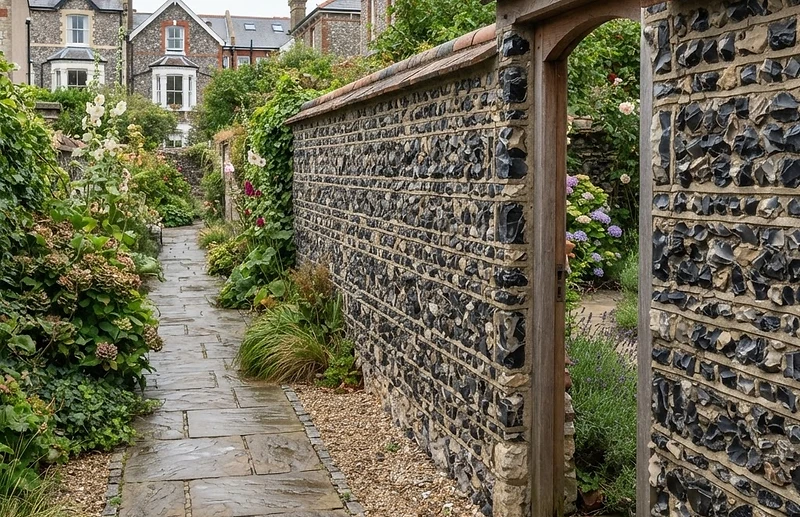
Flint wall repair in Brighton and Hove
Flint wall repair is faced masonry work, not general building. Safe-Bricks assesses, repoints and rebuilds knapped and unknapped flint walls across Brighton and Hove in lime mortars specified to match the original construction.
Flint walling is one of the defining materials of Brighton and Hove: boundary and garden walls, churchyard and estate walls, flint-faced cottages, and the flint elevations that survive between later brick and stucco. It is durable, and where it has been left with its original lime mortar intact it will often stand for two centuries or more with only occasional attention.
Almost all of the failure we are called to is mortar failure. Flint itself is chemically inert and effectively impervious, so it does not weather in the way brick or chalk does. What fails is the material holding it: the bedding mortar, the pointing and, critically, the lime and rubble core behind the visible face.
That is why flint wall repair in Brighton depends far more on correctly specifying and executing the mortar work than on the flints. It is also why hard cement repairs, applied in good faith over the last several decades, are now the single largest cause of damage we record on these walls.
Why Flint Walls Are Not Bungaroosh
Flint appears in both, and the two are frequently confused, but they are different constructions requiring different work.
Bungaroosh is a cast material: flint nodules, brick bats, chalk and rubble tipped into shuttering in lifts and bound in a lime-rich mortar, then rendered or plastered over because it was never intended to be seen. Repair there is principally about consolidating a soft, variable mass, resolving moisture, and reinstating a breathable render.
A flint wall is faced masonry. The flints have been selected, laid and often coursed or galleted deliberately, and the face is the finish. Repair therefore has to satisfy both the structure and the appearance: joint width, mortar colour, flint size, coursing and finish all have to reconcile with the surviving original work either side of the repair.
In practical terms this changes:
- Flint sourcing, since replacement flints must match in type, size and colour
- Joint width and mortar consistency, which differ markedly between knapped and unknapped work
- The finish of the pointing, which is a conservation decision rather than a trade preference
- The extent of dismantling justified, since sound faced work is retained wherever possible
- The need to address the core of the wall, not merely the visible joint
Where a property has both — a bungaroosh elevation and a flint boundary wall, for instance — we specify and price them separately, because the methods are not interchangeable.
Knapped and Unknapped Flint
Understanding which type of flintwork you have determines almost every decision in the repair.
Unknapped flint — field flint, beach cobbles and nodules used broadly as found, with the natural white cortex still on the face — leaves irregular gaps between adjacent stones, so it was laid in generous lime joints, sometimes with small flint splinters, or galleting, pressed into the fresh mortar to close and stiffen the joint.
Knapped flint has been struck to expose the dark, glassy interior and produce flat, roughly squared faces. It permits fine, narrow joints and regular coursing, and it is generally found where appearance mattered: principal elevations, gate piers, prominent boundary walls and ecclesiastical work.
Matching the existing work means establishing:
- Whether the face is knapped, unknapped, or a mixture by elevation
- Whether the work is coursed, roughly coursed or random
- Whether galleting is present, and its size and spacing
- The original joint width, taken from an undisturbed area
- The colour, aggregate and texture of the surviving bedding mortar
- Whether flints were laid on bed or on end, and their typical size
These are recorded before dismantling begins, since once a defective area is taken down the evidence of how it was originally built is easily lost.
The Damage Caused by Historic Cement Pointing
Most of the flint walls we are asked to look at have been repointed in cement at some point since the mid twentieth century, and it is usually the direct cause of the condition the owner has noticed.
The mechanism is consistent. Cement pointing is stronger and far less permeable than the lime bedding mortar and core behind it, so moisture entering the wall — through the top of the wall, a failed coping, a raised ground level, or the pointing's own shrinkage cracks — cannot evaporate through the joint. It is held within the wall instead.
Because the cement is the stronger material, the resulting freeze-thaw and salt action is forced into the weaker historic fabric rather than into the joint. Flints are levered loose, faces spall, the core softens and washes out, and the cement eventually detaches in large plates carrying original bedding mortar with it.
The symptoms we most often record are:
- Loose or missing flints within otherwise hard, sound-looking pointing
- Wide cement bands where the joint has been smeared over the flint faces
- Hollow-sounding pointing that has debonded from the wall behind
- Damp, moss and algae retained on the face long after rain
- Washed-out mortar and voids visible at the top of the wall or behind a failed coping
- Bowing, leaning or bulging where the core has lost cohesion
- Fine cracking following the cement joints rather than the flints
Removal of cement pointing is justified where it is actively causing loss, but it is careful, progressive hand work: cutting out with power tools on a flint wall dislodges more flints than the pointing ever did.
Our Diagnostic Process
We do not quote flint wall repair from a schedule of rates applied to a length of wall. The condition of the core, the cause of any movement and the extent of previous cement work all change the specification, and none of them are reliably visible from a photograph alone.
Our sequence is:
- Establish the construction: wall thickness, solid or faced, knapped or unknapped, coursing and any galleting
- Record the surviving original mortar from an undisturbed area as the reference for the repair specification
- Identify where water is entering — coping, wall top, ground level, adjacent rainwater goods or retained ground
- Assess the condition of the core, including any washed-out or voided zones behind the face
- Measure and record any lean, bulge or displacement, and establish whether movement is historic or progressive
- Map the extent and adhesion of previous cement pointing and other incompatible repairs
- Determine what must be dismantled and what can be retained and consolidated in place
- Specify the mortar mix, joint finish and any replacement flint sourcing
- Set out the repair sequence, including protection, curing and realistic weather constraints
Where movement is progressive, or where a wall is retaining ground, structural input is obtained before dismantling rather than after, since temporary support has to be designed into the method.
Compatible Lime Mortars
The mortar is the repair. A flint wall carries load through its mortar and core, not through interlocking stone, so the mix has to be selected for the wall rather than taken from a standard specification.
The governing principle is that the mortar must be weaker than the masonry, permeable to water vapour, and tolerant of small movements. A correctly specified lime mortar meets all three: it allows the wall to dry, it takes up movement without cracking the fabric, it is sacrificial and can be renewed, and it can be removed in future without damaging the flints.
The binder and the aggregate are both chosen deliberately. Sharp, well-graded sand matched to the original in colour and grading, and a lime specified for the exposure and the season, will produce a joint that reads correctly against the surviving work and performs as the wall was built to perform.
Specification decisions include:
- The lime binder and its gauge, appropriate to exposure and the wall's function
- Aggregate type, grading and colour, matched to the surviving mortar
- Mix ratio, adjusted for bedding, core work and finishing joints
- Joint profile and finish, matched to the original rather than imposed
- Whether galleting is reinstated, and to what pattern
- Protection and curing regime, and the practical working season
Lime work is weather-dependent. Repointing carried out in frost, in drying wind or in high summer heat without protection will fail whatever the mix, so the programme is planned around it.
Work We Undertake to Flint Walls
The scope depends entirely on the diagnosis, and ranges from localised pointing to full rebuilding of a failed section.
Our flint walling work includes:
- Repointing in lime mortar specified to the existing wall
- Careful removal of failed or damaging cement pointing
- Resetting and re-bedding loose or displaced flints
- Consolidating and grouting washed-out cores and voids
- Taking down and rebuilding bowed or failed sections, salvaging original flints
- Reinstating knapped and unknapped faces, coursing and galleting to match
- Renewing or repairing copings, wall tops and weatherings
- Repairing junctions with brickwork, flint quoins, piers and dressings
- Repairs to boundary, garden, churchyard and retaining flint walls
- Making good flint masonry around new or altered openings
Sound original work is retained wherever it can be. Wholesale rebuilding is recommended only where the wall has genuinely lost structural integrity.
Listed Buildings and Conservation Areas
A large proportion of flint walls in Brighton and Hove are listed, curtilage-listed as boundary structures, or stand within conservation areas.
Where works affect the appearance of the wall — its pointing finish, its height, its coping, or the extent of rebuilding — Listed Building Consent or conservation-area controls may apply, and the required specification often shapes the repair method. We advise establishing the position before work begins.
Concerned About a Flint Wall?
If a flint wall on your property is losing flints, leaning or has been repointed in cement, send Safe-Bricks photographs for an initial technical review.
The most useful photographs are:
- The full length of the wall from both sides where accessible
- Close-ups of the pointing, with a coin or tape for scale
- Any area where flints are loose, missing or displaced
- The top of the wall and its coping or weathering
- A view along the wall face that shows any lean or bulge
- Ground levels, planting and retained ground either side
- Any undisturbed area where the original mortar survives
From those we can normally establish the flint type, the likely cause of failure and whether a site inspection is needed before a repair specification can be confirmed.
Related specialist services
Flint wall repair: common technical questions
Not sure where to start?
Send us photographs of the area of concern. It is the most straightforward first step — we will look at what you can see and advise on the appropriate next steps.