
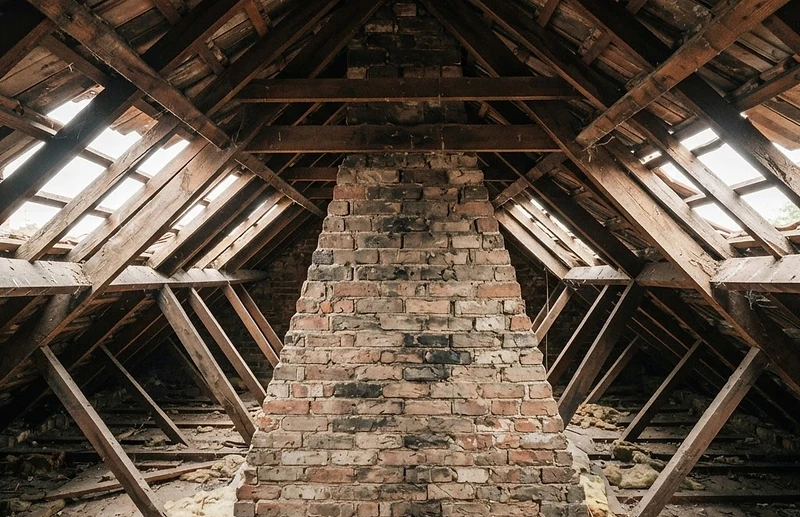
Loft Party Wall Repair in Brighton and Hove
Historic firewalls in period roof voids fail for reasons that can be read in the fabric. Our work begins with understanding why the wall has degraded, and continues with repair in materials the building can tolerate.
Loft party wall repair in Brighton and Hove is specialist masonry work carried out in a confined, dusty and structurally sensitive space. The wall dividing two roof voids in a Regency, Victorian or Edwardian terrace was built by hand, in soft brick or bungaroosh, using lime mortar, and it has since been disturbed by generations of re-roofing, insulation and services work.
Safe-Bricks Limited approaches these walls as heritage fabric. We are restoration specialists rather than general contractors, and the object of the work is a sound, continuous wall that behaves as the rest of the building behaves.
Diagnosis: why historic loft firewalls degrade
Deterioration in a roof void is rarely the result of a single event. The space is unheated, ventilated and exposed to the underside of the roof covering, so the wall experiences a wider range of temperature and humidity than any wall below the ceiling line. In coastal Sussex the air carries salt, and salt crystallising within soft brick and lime mortar erodes the joints from the surface inwards over decades.
Alongside that weathering, the wall is repeatedly interfered with. Purlins, rafters and wall plates pass through it. Roof replacements, loft conversions, cabling and aerial installations open sections of it, and the openings are frequently left unmade. In many properties the wall was never carried fully to the underside of the roof covering, because compartmentalisation between dwellings was not required when the terrace was built.
The conditions we most often record on inspection are:
- Mortar eroded or absent from bed and perpend joints, leaving open brickwork
- Salt crystallisation and surface loss on soft handmade brick in exposed roof voids
- Movement and displacement where the wall is unrestrained at its head
- Gaps where roof timbers and services penetrate the line of the wall
- Sections removed during earlier works and not reinstated
- Water staining and timber decay where moisture has been held against the masonry
- Failed cement patch repairs cracking away from the softer original fabric
These conditions are visible to a surveyor with roof void access, which is why loft firewall defects appear so consistently in homebuyer and building survey reports across the city. The observation itself is straightforward; the value lies in understanding whether the wall is simply incomplete, actively deteriorating, or moving.
Material compatibility: lime mortar and matching period brick
A historic wall manages moisture by allowing it to move through the mortar and evaporate from the surface. Lime mortar is softer and more permeable than the brick around it, so it takes up movement and releases moisture rather than resisting both. That behaviour is the reason these walls have survived at all.
Cement mortar reverses the relationship. It is harder and considerably less permeable than soft handmade brick or bungaroosh, so moisture is trapped within the wall and forced to leave through the face of the brick instead of the joint. In a cold roof void the result is spalling brick faces, salt damage, sustained dampness in the masonry and decay in the embedded timbers bearing on it. A cement repair in a period loft frequently causes more loss than the defect it was intended to correct.
Our material specification follows from that principle:
- Lime mortars selected for the exposure and the density of the surrounding masonry
- Handmade or reclaimed brick matched to the original for size, porosity and strength
- No cement-rich mixes bedded against soft historic brick or bungaroosh
- Mortar joints finished to suit the original work rather than a modern profile
- Curing time allowed between stages, with protection appropriate to the season
Matching brick matters for the same reason as the mortar. A dense modern brick set into a soft wall concentrates stress and moisture at its edges, so replacement units are selected to sit within the range of the existing fabric rather than above it.
Our approach: repair and stabilise rather than replace
Wholesale rebuilding of a loft party wall is seldom necessary and is rarely the least damaging option. Taking down original fabric removes material that has proved itself over a century and a half, disturbs the roof structure that bears on it and generates far more risk in an occupied property.
We therefore work from the evidence: establish the construction and its condition on both faces where access allows, identify how the roof structure bears on the wall, locate any active moisture and deal with its source, then repair the minimum extent required to make the wall sound and continuous.
In practice the sequence is:
- 1Inspection of the roof void, recording construction, condition and moisture evidence
- 2Protection of ceilings, insulation and roof structure, with dust control in place
- 3Careful removal of loose material and of failed cement repairs
- 4Raking out and cleaning open joints back to a sound bed
- 5Retaining and resetting sound original brickwork wherever it can be kept
- 6Rebuilding only those sections that cannot be stabilised in place
- 7Making good around rafters, purlins, wall plates and service penetrations
- 8Closing the head of the wall to the underside of the roof covering
Where a survey has raised the wall as a matter to be resolved, we can review the relevant extract together with photographs of the roof void and confirm whether an inspection is needed before a specification can be prepared.
We do not price work we have not seen, and we do not recommend a repair method before the cause of the failure is understood.
Level 3 survey loft firewall missing mortar
Most enquiries for this work follow a building survey. A Level 3 survey loft firewall missing mortar entry is a specific, evidenced observation rather than a general caution, and it is usually accompanied by a recommendation that the barrier be reinstated by an appropriate contractor.
What buyers, owners and their advisers generally need is an accurate description of the defect, a repair strategy suited to the construction, and photographic evidence of the completed work. We can review the relevant extract from the survey together with photographs of the roof void as a first step, and confirm whether an inspection is required before a specification can be prepared.
Selling a Property Where the Survey Has Flagged the Fire Wall
When a survey records the loft party wall under its most serious condition rating, the transaction usually stalls for a reason that has little to do with the defect itself: nobody involved can yet say plainly what the wall needs. The rating records an evidenced observation the surveyor was not able to clear on the day, and until it is answered, the buyer's lender, surveyor and solicitor each treat it as an open risk on the purchase.
A documented specialist response resolves that position more directly than negotiation over the asking price. We review the survey extract together with photographs of the roof void, confirm whether an inspection is needed, and set out the required work as a written specification. Once the work is complete, we provide a completion record with photographs of the reinstated wall, which can be passed to the buyer's surveyor and solicitor so the flag is answered with evidence rather than assurances.
For estate agents advising a vendor, the sequence is worth understanding in advance. The defect is frequently a defined, describable item of masonry repair rather than a structural problem, and presenting it as such — with a specification and a specialist name behind it — keeps the conversation about the transaction rather than the wall.
We work within the transaction's timetable where the fabric allows it, but the specification follows the wall's condition: a party wall requiring staged lime mortar reinstatement cannot be compressed to meet a completion date, and a report that pretended otherwise would not survive the buyer's surveyor.
Level 3 survey loft firewall questions
Not sure where to start?
Send us photographs of the area of concern. It is the most straightforward first step — we will look at what you can see and advise on the appropriate next steps.